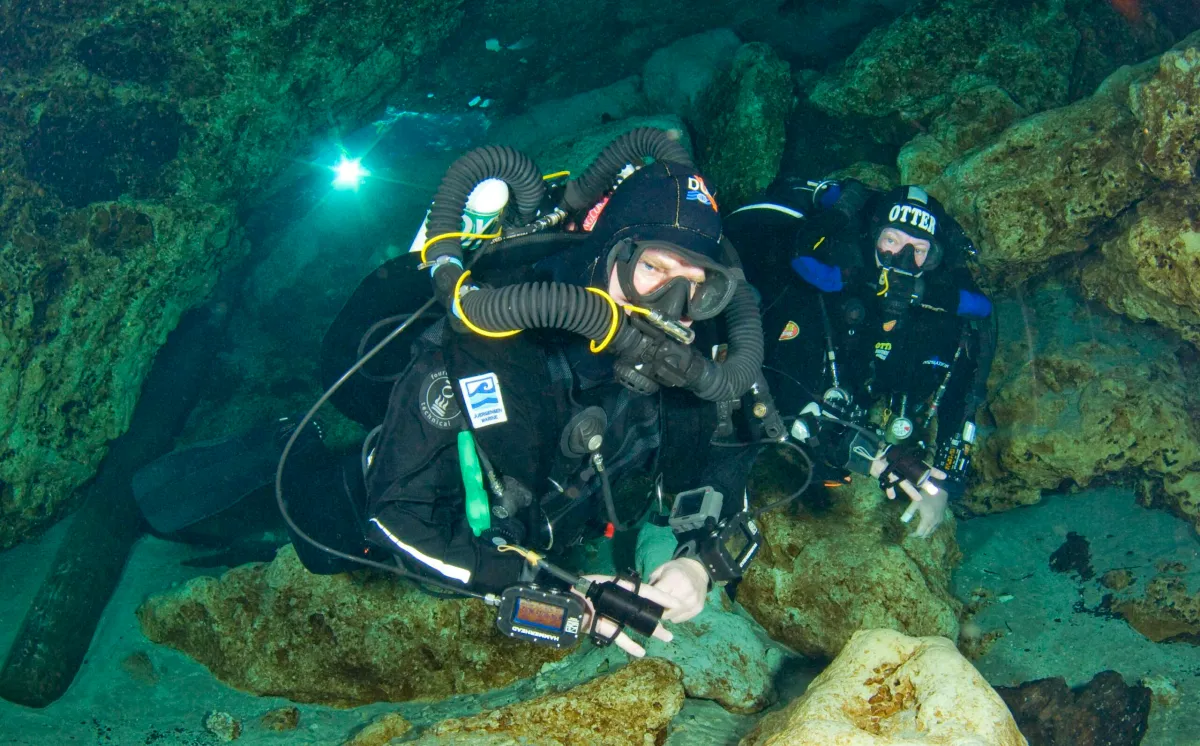
Rebreather Full Cave Diver
The highest level of cave diving certification.
General Information
The Cave Diver 3 course is the third level of training in the series of Cave Diver development programmes. Advanced cave dive planning, the practical execution of different types of cave systems and scenarios divers encounter are presented. This cave diving course is not intended to prepare divers for evaluating all facets of cave diving. The objective of this course is to expand and critique previous skills obtained in the Cave Diving programs. Emphasis is put on dive planning and skill perfection during cave penetration.
The Cave Diver 3 course focuses on advanced cave diving planning and execution. This is the final step in the progression from Cave Diver 1 to Cave Diver 3. Techniques learned through earlier courses are fully developed and refined, with the cave diver exposed to more sophisticated cave diving scenarios.
eCCR / mCCR
We offer courses focused on eCCR and mCCR rebreathers in backmount and sidemount configuration. We tailor the course content and setup to the specific type of unit and the diver's level.
Rebreathers we have experience with include, for example, Submatix Quantum CCR, AP Inspiration and AP Evolution CCR, Poseidon SE7EN+, SF2, Flex CCR, X-CCR, JJ-CCR, Liberty CCR, Revo CCR, T-REB CCR, Triton CCR.
Availability of a specific unit and the possibility of running the course on that type of rebreather must be confirmed individually in advance.
Shark Divers is not the manufacturer of the equipment listed above, and the mention of a specific equipment name is solely for identification purposes.
What Qualifications Do I Need?
- Show proof of a minimum certification of CCR MOD II air diluent decompression Diver or equivalent.
- Certified CCR Intro Cave diver or equivalent.
- Must be a minimum of 18 years old.
- You will need to fill out a self-certification medical statement.
- If you have any medical conditions you think may prevent you from scuba diving, please feel free to contact us and we will try to be of assistance.
What Makes A Class Different?
- More knowledge!
- More Practical Skills & Emergency Drills
- Focus on have better, more comfortable and safer divers
Course Duration
Minimum eight (8) practical lessons in at least five (5) days. Minimum of eight (8) dives are performed in a minimum of three (3) different caves.
What's In The Course?
The participant shall have appropriate knowledge concerning the physical principles and their application to Cave Diving 3 (Full Cave) equipment and hazards relating to:
- Definitions of Cave Zones, Training Standards and safety rules for the safe exploration of Zones
- Gas matching procedures and management
- Calculation of gas consumption and of required gas supply
- Specific techniques and procedures such as organising tank deposits, requirements for long distance penetration, usage of stage tanks, mastering squeezes and post-sump diving
- Communication: Hand signals, light signals, touch contact signals
- Swimming Techniques: Trim & buoyancy control, Propulsion techniques
- Special requirements of underwater orientation in caves
- Deploying and Line following
- Physiology: Breathing techniques, Stress management
- Causes, symptoms and effects of nitrogen narcosis, oxygen toxicity and being short of breath
- Decompression Theory and its application to cave diving
- Cave environment: Geology (Bottom, ceiling), Local access requirements, Land owner relations
- Cave mapping (cross-sections, distances, topology)
- Cave conservation
- Problem Solving procedures
- Organisation of further support actions and alarming of rescue squad
- Execution of rescue activities in the cave and complete accident management
- Accident analysis
- Review of Dive Tables and Decompression theory
- Cave Diver's Etiquette
Practice In Water
- Equipment check and gear matching;
- Pre-Dive check, bubble check;
- Demonstrate specialized propulsion techniques in varying types of flow;
- Demonstrate proper buoyancy & trim control;
- Demonstrate proper stress analysis (detection and management);
- Properly deploy a guideline;
- Properly use directional and non directional line markers;
- Properly follow a guideline with eyes open and closed (simulating loss of visibility);
- Gas sharing with a buddy with eyes open, following the guideline;
- Gas sharing with a buddy with lights off, eyes closed and use touch contact, following the guideline;
- Remove and replace mask while in contact with guideline;
- Demonstrate light / hand-signals and touch contact;
- Conservation and awareness techniques;
- Referencing as back-up navigation;
- Simulate a primary light failure, and use back light to exit the cave;
- Demonstrate lost line and lost diver drills;
- Demonstrate use of reels to perform jumps and gaps required in circuits and traverses to maintain a continuous guideline to open water and cave.